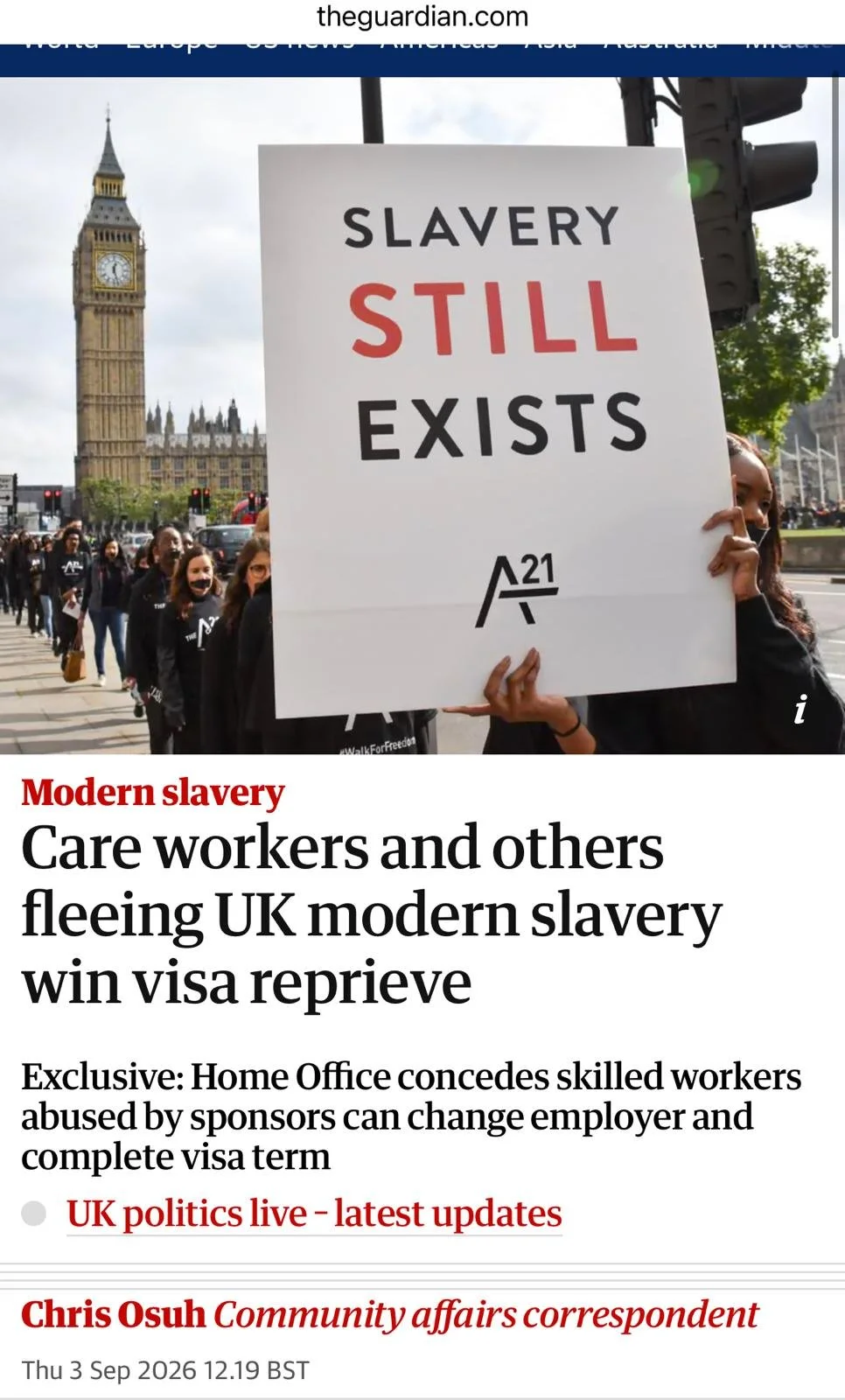
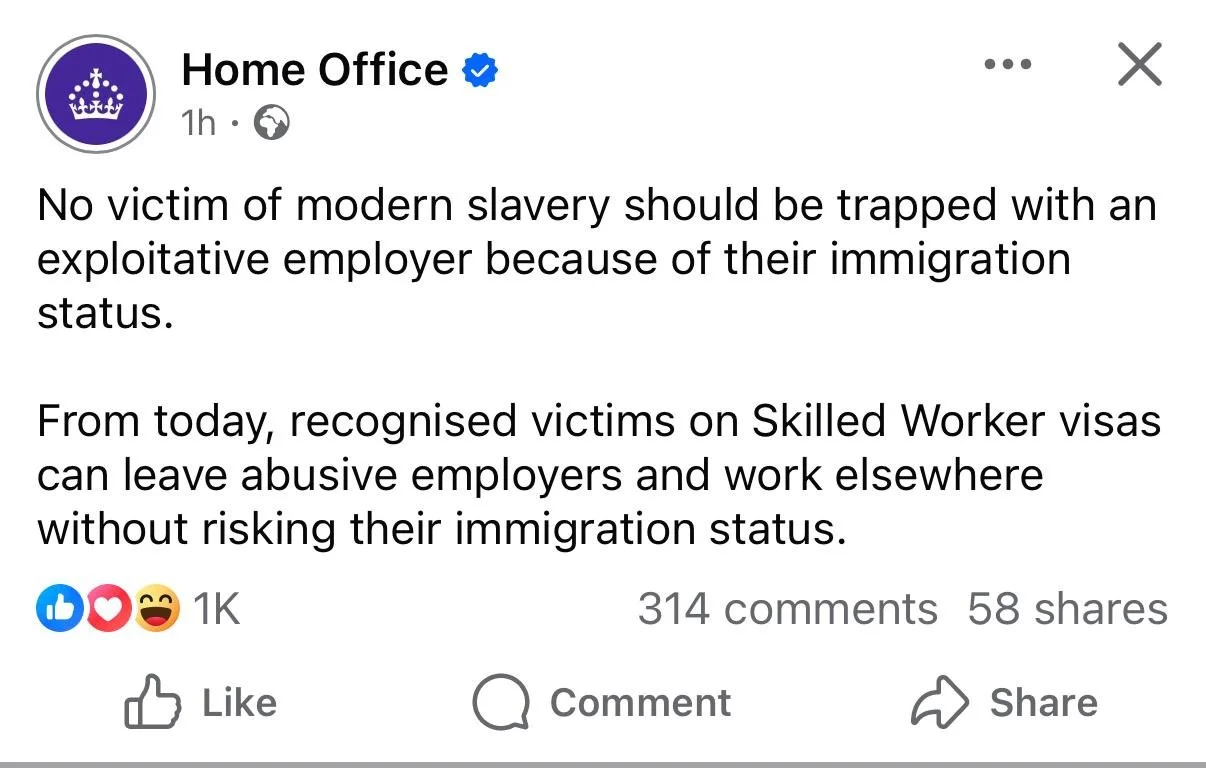
On 3 September 2026, The Home Office shared on their social media page that No victim of modern slavery should be trapped with an expliotative employer because of their immigration status.. The Guardian also published: Care workers and others fleeing UK modern slavery win visa reprieve.
This is a significant development for sponsored care workers and other Skilled Workers who have been exploited by their employers.
Normally, a person on a Skilled Worker visa is tied to the employer sponsoring them. If they leave that employer, they generally need another licensed sponsor, a new Certificate of Sponsorship and a successful change-of-employment application before they can work for the new employer.
That creates a serious problem where the sponsoring employer is the person exploiting the worker. Some workers have effectively faced a choice between:
stay with an abusive employer or leave and risk their immigration status.
According to the Home Office announcement reported by The Guardian on 3 September 2026, that is changing for people who are formally recognised as victims of modern slavery.
The reported new position is:
If a sponsored worker receives a positive “Conclusive Grounds” decision under the National Referral Mechanism (NRM), the restriction tying them to their sponsoring employer can be lifted. They can then work for another employer for the remainder of their existing visa.
That could be especially important for care workers who have been trapped with exploitative sponsors.
But there is an important qualification
It does not appear to mean:
“My employer treated me badly, therefore I can immediately leave and work anywhere.”
The article specifically says the protection applies following a positive Conclusive Grounds decision under the NRM. The NRM is the government’s system for identifying victims of trafficking and modern slavery.
There are broadly two stages:
Reasonable Grounds: Is there reasonable evidence to believe the person may be a victim?
Conclusive Grounds: Having considered the evidence, is it more likely than not that the person is a victim of modern slavery?
The Guardian report indicates that it is the positive Conclusive Grounds decision, not simply making an allegation or being referred into the NRM, that triggers this particular freedom from the sponsor.
What does “modern slavery” actually mean?
People sometimes hear the word slavery and imagine somebody literally being locked up or chained.
Modern slavery is much broader than that.
In UK law it includes slavery, servitude, forced or compulsory labour and human trafficking. It commonly involves somebody being controlled, coerced, threatened or deceived so that another person can exploit their work or services.
In the care sector, imagine this situation:
A worker is recruited overseas and promised:
“Come to Britain. You will earn £25,000. You will work 40 hours a week. We will sponsor you.”
They borrow £10,000 to £20,000 to pay recruitment or other fees and arrive in the UK.
Then they discover:
there are only 10 or 15 hours of work;
wages are withheld or unexplained deductions are made;
they are told they owe the employer thousands of pounds;
their passport or documents are taken;
they are threatened with losing their sponsorship;
the employer tells them, “If you complain, I will cancel your visa and you will be deported”;
they are forced to work excessive hours;
they cannot freely leave the employment because of threats, immigration pressure or debt;
their accommodation may also be controlled by the employer.
Those are the kinds of circumstances that can point towards forced labour or modern slavery. Government guidance specifically identifies indicators including threats concerning immigration status, withholding passports, restriction of movement, debt bondage, withholding wages, excessive hours and deception about employment.
One distinction is very important
A bad employer is not automatically a modern-slavery employer.
For example, an employer failing to pay holiday pay, making an unlawful deduction, breaching a contract or even underpaying minimum wage may amount to serious employment-law or sponsorship breaches.
But modern slavery usually involves something more, exploitation combined with coercion, control, threats, deception or abuse of vulnerability, such that the worker’s ability to walk away is seriously compromised.
And immigration status can itself become the mechanism of control:
“If you leave me, I’ll cancel your sponsorship.”
That is particularly significant because official guidance recognises threats to report someone to immigration authorities or exploit their immigration status as potential indicators of forced labour.
Why today’s change matters
For many migrant care workers the sponsored visa has created a power imbalance.
The employer was not simply the employer, the employer was also the sponsor on whom the person’s ability to remain and work in Britain depended.
The Guardian reports that some rogue sponsors exploited that vulnerability through underpayment, excessive hours and zero-hours arrangements. More than 6,600 sponsors have reportedly lost their licences since the current government came to power, including more than 4,400 in the year to June 2026.
The new protection is therefore essentially saying:
If the UK has formally concluded that you are a victim of modern slavery, you should not be forced to continue working for the person exploiting you simply because that employer sponsors your visa.
That is the really important point.
The existing published Skilled Worker caseworker guidance I found is dated 3 August 2026 and still contains the ordinary change-of-employer rules; the detailed Home Office guidance implementing today’s announced concession will need to be checked as it is published.
This article provides general information only and is not a substitute for immigration advice about an individual’s circumstances. Immigration Rules and Home Office policy can change. The information should therefore be checked against the rules in force at the date of any application.
Not sure how these changes may affect you and Need immigration advice?
Book a consultation with one of our specialist immigration solicitors today. We will assess your circumstances, explain your options and help you submit the strongest possible application.
Book a consultation to speak to an immigration adviser HERE